Friday, November 27, 2015

The Care and Feeding of the Steam Locomotive


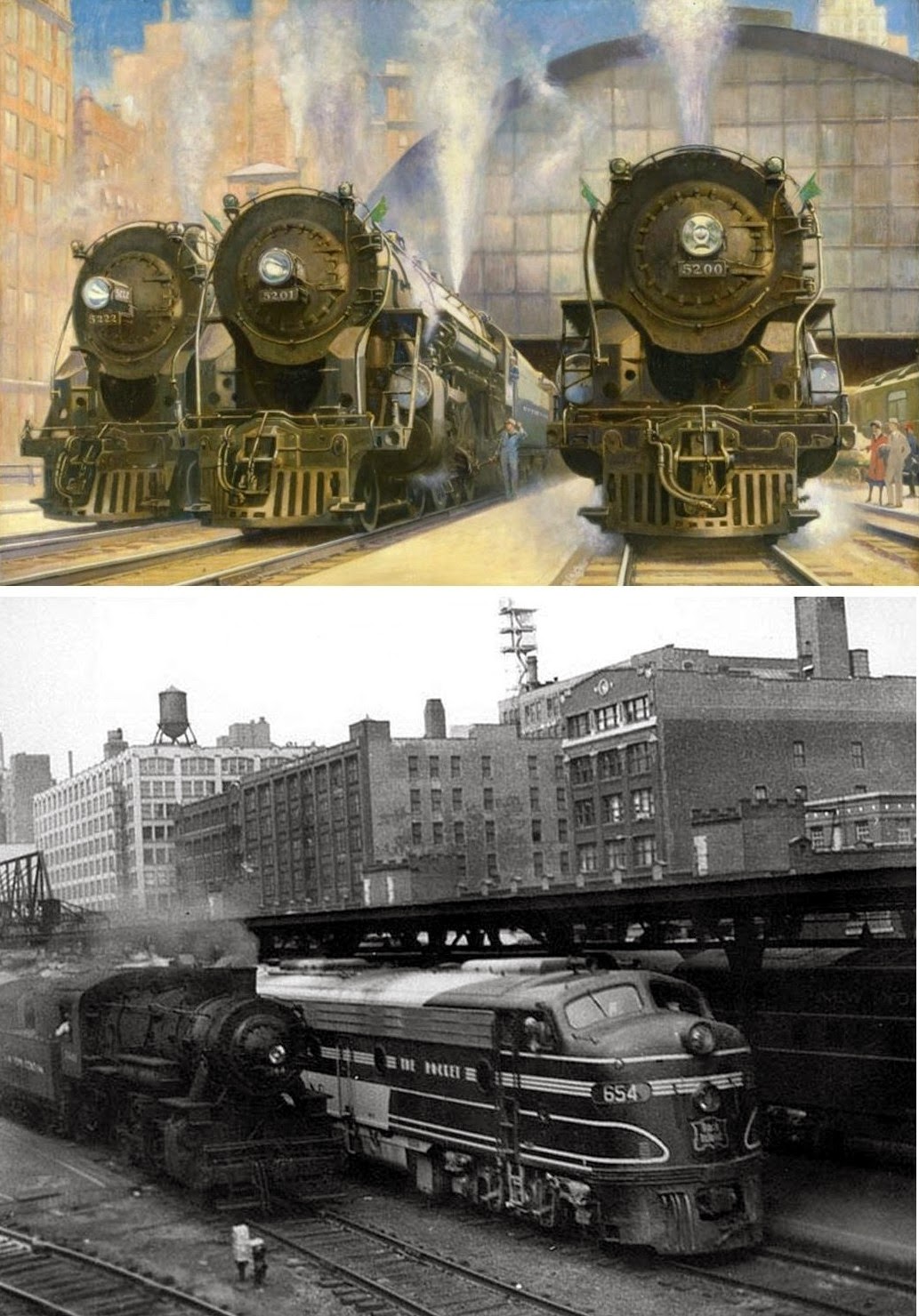
The steam locomotive has often been portrayed as a living beast, with steaming breath and a voracious appetite for coal to feed it's fires.  The steam locomotive was an intricate piece of machinery with thousands of moving parts that required constant servicing and maintenance.  To accomplish this the railroads established facilities and shops that employed hundreds of employees with specialized skills.  These shops dotted the landscapes in cities and towns across the country and Chicago being the focal point of so many railroads, was no exception.


The essential component of any servicing facility was the roundhouse.  They varied in size and number, depending on the volume of locomotives using the rail yards they operated from.  The roundhouse was a semicircular structure that surrounded a pivoting piece of track mounted on something similar to a bridge girder.  The turntable could rotate 360 degrees to line up with any track that led into an individual stall in the roundhouse.  It also allowed for the locomotive to be "turned" so that the front of the locomotive faced the desired direction pf travel.  The tender, that part of the locomotive used to store the coal to fuel it, was meant to be behind the the locomotive when it was attached to the train.


The roundhouse was used for basic servicing, such as inspection, cleaning and lubrication.  Located near the roundhouse were water tanks, coaling and sand towers.  The locomotives were moved around the servicing area by employees known as "hostlers".  The hostler would move the locomotive in and out of the roundhouse and position it to take on water, coal and sand.  Sand was critical for giving the locomotive traction on the steel rails, especially when starting the train from a standing stop.


Larger servicing facilities also included "back shops".  This collection of buildings was used for heavy repairs and rebuilding.  Many of the larger railroads modified locomotives to modernize them.  Some even had the facilities to build their own locomotives.  The back shop would include buildings with heavy duty overhead cranes used to disassemble a locomotive.  There were boiler shops where boilers were "retubed" to extend their life.  New steel tires were added to the drivers to replace the worn ones.  The final step in the heavy servicing would be a trip to the paint shop for a fresh coat.


Steam locomotives required frequent service.  Upon the return from each trip on passenger or freight the locomotive would receive the required service.  There was a prescribed maintenance schedule the railroads followed set forth by the Federal government.  Federal inspectors insured that the railroads adhered to the scheduled maintenance.  Each locomotive represented a major investment on the part of the railroad.  Many locomotives would be modified and rebuilt to extend their life and improve their performance as new technologies were developed.


All this work amounted to a huge specialized workforce: sheet metal workers, machinists, boiler makers, carpenters and so on.  The advent of the diesel locomotive changed this.  The diesel did not require the constant maintenance the steam engine did.  They could operate for longer periods of time with little more than refueling and minimal inspection.  The railroads embraced the new technology once it was shown to improve the basic bottom line of operations.  Those facilities and people that were needed to take care of and feed the great iron beasts were no longer needed.  The railroad drastically reduced their work forces and would abandon and eventually demolish the acres of buildings once dedicated to steam engines.


Friday, September 11, 2015

The Grandest Station of All


Grand Central Station in Chicago is now a distant memory to many of the remaining few who may have used or seen the station.  In its place there is a vacant lot that is a reminder of the fortunes of railroads and passenger trains in the years following World War II.  It is also a reminder of the lack of civic appreciation for those grand structures that have outlived their original purpose.  Grand Central was not Chicago's busiest train station, but was the most architecturally significant of the 6 major terminals that helped to define the railroad capital on the nation.  It hosted a group of minor players in the railroad passenger market and was relatively small in terms of the number of loading tracks (6).


Construction of Grand Central was begun in 1889 for the Wisconsin Central Railroad (WC) on the southwest corner of Harrison and Wells Street (then called Fifth Avenue). It was located adjacent to the South branch of the Chicago River and built to replace a temporary station near that location.  Architect Solon S. Beman was chosen for the project, likely based on his designs of the Pullman factory complex and town built between 1880 and 1881.  Beman chose a Norman Castellated style for the structure featuring an immense 247 foot bell and clock tower.


Built of brick, brownstone and granite it featured imposing arches, crenellations and a profusion of turrets along its walls.  An arched carriage court faced Harrison Street.  Confronted with the city's swampy soil conditions Beman placed the tower on a floating foundation supported by pilings sunk 55 feet deep.  This foundation supported the weight of the tower, including its 11,000 pound bell that was designed to ring on the hour.  The tower included a 15 foot clock, at one time one of the largest in the United States.  The station headhouse was 228 feet wide by 482 feet long.  The interior was finished with the finest materials, including marble and stained glass.  The building also included a 100-room hotel that only lasted until 1901.


Beyond the station was the 6 track train shed covered with a self-supporting steel and glass structure, among the largest in the world and an engineering marvel in its own right.  Opened on December 8, 1890, the final cost upon completion was 1 million dollars.  During its construction the station and trackage were purchased from the Wisconsin Central by the Northern Pacific Railway, who sought access to the Chicago market.  Their ownership was equally short-lived as the railroad went bankrupt in 1893 and was forced to sell the station and their Chicago trackage to one of the station's tenants, the Baltimore and Ohio Railroad (B&O).  The B&O created a subsidiary called the Baltimore and Ohio Terminal Railroad to control the tracks from Forest Park to Blue Island, including the stations tracks.


The station would eventually be host to the B&O, the Minneapolis, St. Paul and St. Marie (aka Soo Line, successor to the WC), the Pere Marquette and the Chicago & Great Western.  At its peak it saw only 40 daily intercity trains.  These roads comprised the smallest share of the railroad passenger market in the city.  Political leaders in Chicago began to agitate for a consolidation of railroad passenger operations into one terminal, a project that never came to fruition.  Stations like Grand Central were perceived to be obsolescent white elephants rather than the grand palaces of transportation envisioned by their builders.  The contraction of intercity rail passenger service in the late '50s and '60's would do what the city planners could not.  The railroads were forced to consolidate their trains into Union and Northwestern Stations for reasons of economy.  Intercity passenger trains began operating under the auspices of Amtrak in 1971.  In 1969, the year Grand Central closed, an average of only 210 passengers passed through its doors on a daily basis.


B&O closed the doors of the station on Saturday November 8, 1969.  The building would stand abandoned until it met its date with the wrecker's ball in 1971.  People may question the wanton destruction of an obviously valuable landmark and it comes down to this simple explanation: taxes.  Land with a building is considered improved land and taxed at a higher rate than vacant land.  Railroads are a business, and that does not include architectural preservation of an unused asset.  The City of Chicago has been notably shortsighted in the preservation of its architectural heritage, and no one stepped forward to preserve the station for future generations.  It appears there may have actually been an agreement between the railroad and the South Park Commission to turn the area into parkland.  This never happened and the land is still languishing and waiting for development.  A portion of the land formerly occupied by tracks is now the site of a housing complex known as River City, designed by noted architect Betrand Goldberg.


Numerous ideas have been proposed for the land, including a casino.  One of the more interesting pipe dreams is a plan to build a station for high speed rail service.  The architectural renderings evoke the memory of the old station and its clock tower.  For now, all we have are weeds and memories.

Proposed High Speed railroad station at the site of Grand Central Station

Thursday, September 10, 2015

A Little Railroad in a Big City


The design of this Illinois Northern steam engine was typical for switch
engines that operated at lower speeds and required greater tractive effort.

Being the historic railroad center of the nation, Chicago hosted many of the major players in the railroad landscape.  The city was also home to a number of smaller industrial and transfer railroads that played an equally important role in the movement of raw materials and finished products for interchange with the larger railroads.

Illinois Northern's McCormick freight transfer station.
 
The Illinois Northern was one of those railroads, only 8.45 miles in length including main and yard tracks, it was incorporated on May 15th in 1901.  It was initially owned by the International Harvester Corporation, who would eventually go on to lease the railroad to a consortium of other railroads.  Built to service the massive McCormick works on the city's near-South side, it eventually included other industries that located in the immediate area.

A partial aerial view of International Harvester's McCormick Works.

In 1902 portions of the railroad were leased to the Atchinson, Topeka and Santa Fe Railway, the Chicago, Burlington and Quincy Railroad, the Chicago & Illinois Western Railroad and the Chicago Junction Railway.  Each railroad paid a proportionate share of taxes and maintenance as part of the lease agreements.  Aside from International Harvester a number of industries were enticed to locate along the tracks, attracted by rail access and proximity to the South branch of the Chicago River.  Water was often an essential element in manufacturing and this ad for the railroad touts proximity to both the river and the Chicago drainage canal, built in the late 1800's to reverse the flow of the Chicago river system to remove the city's sewage from the lake.  Notable as well is the number of railroads the IN interchanged with.


The Santa Fe would later become the sole owner of the IN which would eventually transfer to the Burlington Northern Santa Fe via merger.  As industry slowly disappeared along the line the BNSF petitioned the Interstate Commerce Commission for abandonment in 1999.  Two shippers protested the petition, which was declined by the ICC.  In 2001 the Central Illinois Railroad leased and assumed operations of the IN which continued until they declared financial losses in 2010, whereupon the BNSF resumed operation and subsequently abandoned the service.

Illinois Northern swing bridge over the Sanitary and Ship Canal.

While the tracks have since been removed, one reminder of the line still exists and is designated as an official Chicago landmark.  The double track swing bridge, one of the few of this type remaining in the city, was built by the Sanitary District as part of construction of the drainage canal and today known as the Sanitary and Ship Canal. The Pratt through truss bridge, built in 1897 by the Keystone Bridge Company, stands as a testament to a small railroad that played a major role in Chicago's industrial history.

Sunday, January 18, 2015

Death Rides the Rails

Henry Keckeisen's death certificate
Railroading can be a dangerous profession.  When I worked for the railroad I had a number of what I would call "near death" experiences where my life could have been forfeit if not for luck or a quick thinking coworker.  I recently received an email from someone who had read this blog and wanted to share the story of her great grandfather.  It is a story that has been repeated all to often over the years.

Pere Marquette locomotive taking on water
Henry Keckeisen was a locomotive engineer for the Pere Marquette Railroad in Chicago in 1909.  The Pere Marquette operated passenger trains out of Grand Central Station.  On August 11th, 1909 Keckeisen was backing his locomotive down to the station in poor visibility.  This movement required him to put his head out of the locomotive cab window to improve his visibility.  It's first important to understand that the steam locomotive did not afford much opportunity for good visibility when operating it in either direction.  The boiler to the front and the coal/water tender to the rear were large obstructions to the engineer's sight lines.  Both the engineer and fireman would be sticking their heads out the cab windows to watch for interlocking signals and the proper positioning of switches for their movement.  Given the poor visibility of the day Keckeisen's attention would have been focused on that task.

Water spout
What he did not see was the water spout that had been left in the lowered position rather than stored in an upright one.  Steam locomotives required copious amount of coal and water, and it was the responsibility of the fireman or locomotive hostler to fill the tender with these commodities and safely stow the chutes and spouts after use.  I would assume that Keckeisen was in the engine terminal where these supplies were found.  In that case all the switches that he would have to safely move his locomotive over were hand operated and could be left lined in any position.  One of the cardinal rules of railroading is to ensure that all switches are properly lined for safe movement.

Typical track arrangement in a railroad yard with hand operated switches
Keckeisen was struck in the head by the lowered water spout and died of his injuries two days later.  We do not know if the spout had been inadvertently left down by a distracted employee or if there was a mechanical problem that would not allow it to be raised into a safe position.  He left a widow, Francis, and a young child.  The tragedy was compounded 13 days later when his wife Francis succumbed to tuberculosis.  Henry was 28 and his wife was 29.  Five year old Earl Edward was left an orphan in the care of his 85 year old grandfather, and later his aunt.

On August 17th a lawsuit was filed in the Circuit Court of Cook County against the Pere Marquette and the Chicago Terminal Transfer Company, owner of the tracks for the amount of $10,000 by Francis.  After her death the lawsuit was pursued by Keckeisen's father and sister. Henry Sr. also petitioned for burial expenses which were paid.  In 1910 the railroads offered a $3,000 out-of-court settlement which the lawyers urged the family to accept.  After court and legal expenses they received a little over $2,000.


In an era before the Federal Railroad Administration and National Transportation Safety Board, there appears to be no more than a cursory investigation into the cause of this fatal accident.  Today, private law firms specializing in railroad injury and death claims are available to employees and their survivors.  Railroad Retirement provides death and survivor benefits.  Federal regulatory agencies carefully monitor railroad safety and will levy fines against railroads for violations.  Despite all this, the job remains inherently dangerous.  Railroads still continue to try to coerce employees and families into settlements to avoid costly litigation.  Many railroaders today still define a good day at work as when you can come home and haven't gotten fired or killed.

Special thanks to Cathy Keckeisen Razor for the information used in this post.


Saturday, December 13, 2014

The Saga of LaSalle Street Station


The two principal owners of LaSalle Street Station.

In 1851 the Chicago and Rock Island Railroad incorporated and began construction of a line between Chicago and Joliet, which was completed in 1852.  That same year the Northern Indiana and Chicago Railroad reached Chicago, the first Eastern railroad to reach the city.


 This 1862 map shows the first station.

The first LaSalle Street station was constructed at the foot of Van Buren Street at LaSalle Street and opened on May 22, 1852 coinciding with the completion of the Northern Indiana and Chicago. The Rock Island began using the station soon after on October 1, 1852. The NI&C would later become the Lake Shore and Michigan Southern Railway (LS&MS), a subsidiary of the New York Central Railroad, and the Chicago, Rock Island and Pacific Railroad (CRI&P). Both companies shared a right-of-way to the terminal north of their intersection at Junction Grove, later known as Englewood.  There appears to be no illustrations or photographs of the first station, although it does appear on early maps.  It was probably a humble structure made of wood, similar to other early railroad stations in the city’s central business district.  With the rapid growth of passenger traffic a larger station was called for, and construction of the new building began on April 16th of 1866.

 
 Architect Boyington and his masterwork.
 
Completed in November of 1866, it was designed by architect W.W. Boyington. Boyington is best known as the architect of the iconic Chicago Water Tower. Designed in the “Franco-Italian” style, the station building measured 542 feet by 160 feet.  The balloon type train shed roof spanned five tracks, three tracks for departing trains and two for trains arriving. The Howe Truss roof stood 60 feet above the platforms and was covered with slate. The west side of the building contained a number of rooms for the accommodations of travelers waiting for the departure of trains. These rooms connected with the platform within the depot, and fronted on Sherman and Griswold streets. Each railroad using the depot had baggage rooms, oil and lamp rooms, conductors’ room, and large waiting “apartments” for ladies and gentlemen. There were rooms for second class passengers and immigrants, as well as a restaurant and ladies dining room.  The Van Buren Street facade featured a frescoed entrance hall. On the east side of this hall were the offices of the Michigan Southern and Northern Indiana Railroad Company. On the west side of the hall were the offices of the Chicago, Rock Island and Pacific Railroad.


The fire ravaged remnants of the station.
 
The Great Chicago Fire of October 1871 destroyed the station, which was rebuilt and expanded with additional stories shortly afterwards. From its completion in 1882, the New York, Chicago and St. Louis Railroad (Nickel Plate Road) ran over the Lake Shore and Michigan Southern Railway from a junction at Grand Crossing neighborhood north to downtown Chicago, where it had its own terminal south of LaSalle Street Station at 12th Street. The LS&MS quickly gained control of the Nickel Plate, and later allowed it into its LaSalle Street Station as a tenant. The station was also served by a direct link to the elevated rapid transit system.

The rebuilt and expanded station.

The direct connection with the elevated train was a major advertising point.
 
On December 20th 1901 the trains using the station were shifted over to Grand Central Station and the post-fire station was demolished to make way for a new station designed by the architectural firm of Frost and Granger. The initial plans called for an 8-story steel-framed office building with a station on the first three levels. By the time construction started an additional 4 stories were added.  The construction of the station coincided with the raising of the platform tracks above street level.  The station design included a massive balloon shed covering eleven tracks.  The limestone facade of the old station was ground up and used in the concrete for the foundation of the new station.  The station opened for business in May 1903, and cost close to $2,000,000.

Plaster model of the station's initial design.

 
Construction photographs.

Postcard images and photographs of the station's exterior.

Photographs of the station's interior.
 
Among the most famous name trains that terminated at LaSalle were the New York Central's 20th Century Limited from 1902 until 1967 and the Rock Island-Southern Pacific Golden State Limited from 1902 until 1968.  Most intercity rail service at La Salle ended on May 1, 1971 when Amtrak consolidated long-distance services at Union Station. Rock Island opted out of Amtrak and continued to operate intercity service from LaSalle until 1978. The station was a set for Alfred Hitchcock's 1959 North by Northwest, starring Cary Grant and Eva Marie Saint, and in the 1973 movie The Sting starring Paul Newman and Robert Redford.

 
The New York Central's and Rock Island's crack passenger trains operated out of the station.
  
The Rock Island fell on hard times in the 1960’s and filed for bankruptcy on March 17, 1975, and the station continued to serve as a commuter terminal while the bankruptcy wound its way through the courts.  The plight of the Rock and other commuter services was impetus for the formation of the Regional Transportation Authority in 1974.  In 1980 the bankruptcy judge liquidated the assets of the railroad, completely ending operations on March 31, 1980.  The RTA purchased the commuter service that did not include the station, which had become decrepit after years of deferred maintenance.  In 1984 the RTA created Metra as the operating agency for Chicago’s regional commuter railroad service.

 
By the time the RTA assumed commuter operations the station had become decrepit.

The Chicago Pacific Corporation, a shell corporation, was created from the remains of the railroad to sell off its assets including the station. The station was then sold to the Chicago Board of Options Exchange who demolished it in 1981 and replaced it with a new office tower and trading floor.  This essentially severed the former station's link with Van Buren Street and pushed  the platforms south of Congress Parkway.  Exit from the station is now accomplished by two narrow enclosed corridors on the LaSalle Street and Financial Place sides of the new building.  A small “station” was added to the building in 1984.

 
LaSalle Street Station was replaced by One Financial Place.

In 1985 the Chicago Pacific Corp. announced plans with other landholders to develop 150 acres in the area that would require the station to be moved two more blocks south and a block east.  Other plans called for Metra to move the Rock Island service to Union Station to accommodate the development plans.  Yet another plan called for the tracks to be depressed below grade along with the platforms and waiting room. Competing studies weighed the merits of these plans, but Metra and the RTA balked and brought public and political pressure on the developers to abandon their plans. Metra’s plans for an improvement project to rehabilitate the platforms were stymied by this battle.  After two years Metra won its battle and the tracks and platforms remained.


 Metra's present day LaSalle Street Station.
 
Viewed from today’s perspective the continued presence of the tracks has not been a hindrance to development in the area.  The plan to move the trains to Union Station would have proved to have been a transit nightmare as Union Station is now at capacity.  Although only Metra's Rock Island District trains now use LaSalle, additional service is planned. Metra's proposed Southeast Service would terminate at LaSalle, and Chicago's massive CREATE infrastructure improvement program would allow trains from Metra's Southwest Service to use the terminal.  In June 2011, The Chicago Department of Transportation opened the LaSalle/Congress Intermodal Transfer Center alongside the station as a bus terminal to serve people transferring to CTA buses as well as Blue Line trains at LaSalle.


 The Chicago Transit Authority's Intermodal Transfer Center.
 
The final lesson in the history of LaSalle Street Station is the failure to incorporate a new station into the Board of Options Building.  Commuters became an afterthought rather than an asset.  When the Chicago & North Western Madison Street Station was demolished it was replaced by an office building that included a train station.  The station is filled with the kind of shops and restaurants that one would expect in a modern urban transportation center.  As it stands now the present LaSalle Street Station is little more than a cattle trough with a miniscule waiting room.  At best it’s a monument to missed opportunities to create a transportation nexus worthy of its predecessors.

 
 Development continues to take place despite the presence of the tracks to LaSalle Street Station.

Sunday, November 2, 2014

The Chicago Railroad Fair


In 1948 and 1949 America's Railroads celebrated the 100th Anniversary of the first train to operate in Chicago with a grand public exhibition of their history and progress.  The Chicago Railroad Fair represented a remarkable cooperative effort among the nation's railroads to depict the role of Chicago as the epicenter of the American railroad industry.  Through an amazing display of equipment including more than 30 locomotives, as well as a daily pageant depicting the history of America's railroads, the public was given glimpse into the past, present and future of the rail industry.
 
Locomotive "Pioneer" Arrives at the Railroad Fair

The initial idea for the Fair was conceived by Francis V. Koval, the publicity manager for the Chicago & North Western Railroad, as a commemoration of the 100th anniversary of the first train to operate in Chicago in 1848.  Koval imposed upon the Chicago Tribune to host a dinner for the various railroad presidents where the idea of a centennial celebration was presented.  The Fair developed from that dinner meeting.

Major Lenox R. Lohr

The president the National Broadcasting Company and Museum of Science and Industry, Major Lenox R. Lohr, was elected president of the event.  Lohr was a master a bringing together the various elements that were required for a successful event, with previous experience as business manager of the Century of Progress.  Historian Ed Hungerford was hired to write the pageant script while the official song of the fair, "Wheels a-Rolling", was penned by Evanstonians Mr. and Mrs. Phillip Maxwell.

Sheet music for the Wheels a-Rolling theme song

 Past meets the present at the Fair
"The General", made famous by the Civil War chase

37 American railroads served as sponsors, subscribing $1.25 million to the effort.  Additionally many lines provided rare equipment for display such as the "Stoubridge Lion" of 1829, the B&O's "William Mason", the famous Civil War locomotive "The General" as well as the C&NW's own "Pioneer" locomotive.  The public was treated to a plethora of mighty modern steam locomotives as well as General Motors FT diesel locomotive that would radically change the railroad industry.

The grand parade on State Street

The opening of the Fair was preceded by a gala parade held on July 19, 1948.  Starting at Columbus Drive in Grant Park at 1:30 PM, the parade traveled up Jackson Boulevard to State Street then north to Wacker Drive.  The widow of Casey Jones rode in an automobile at the head of the parade followed by floats, replica locomotives and a military contingent of Army, Navy, Marine and National Guard soldiers and sailors.

The main entrance of the Fair

The official opening of the fair began with a flag raising at 10 am on July 20th at the Fair's main entrance at 23rd Street, with Major Lohr presiding.  The fair covered 50 acres between 20th and 30th Street, taking advantage of the abandoned fairgrounds from the Century of Progress Fair of 1933.  Parking was provided for 1,800 automobiles, which represented an ironic bow to a form of transportation that would effectively destroy rail passenger service.

Recreation of the Golden Spike at the Wheels a-Rolling pageant

Admission to the Fair was 25 cents, and another 60 cents for a ticket to the gala "Wheels a-Rolling" pageant.  A narrow gauge train ride around the Fair cost 10 cents.  The pageant consisted of 12 scenes, along with a prologue and epilogue, telling the dramatic story of America's rise from wilderness to mighty industrial nation victorious in war.  Presented in an outdoor theater seating 6000 with Lake Michigan as the backdrop, 4 daily shows of one-and-a-quarter hours presented this grand story to millions of attendees.

Union Pacific EMD F3 diesel electric locomotive on display

At least 18 locomotives operated under their own power along with 220 performers with 18 different period costumes.  Horse and motor driven vehicles were also included.  30 additional locomotives and pieces of equipment were part of the general exhibition outside the theater.

Passengers climb onto a San Francisco cable car.
At one time Chicago had the largest cable car system in the country.

Visitors could ride an authentic San Francisco cable car, see American Indians perform at Santa Fe's Indian village, see a rodeo or visit "Florida in Chicago" compliments of the Chicago & Eastern Illinois Railroad.

 American Indians perform native dances at the Fair


The Fair proved so popular it was reprised in 1949, and represented a sort of last public hurrah by the rail industry.  The Second World War saw America's railroads perform a stellar job of moving freight and passengers under great duress.  Wartime restrictions on modernization had placed the railroads in a poor competitive position to deal with the rise of the automobile, airline and trucking industries.  By the 1950's the creation of the interstate highway system and the continued application of restrictive regulations on railroads would further drive the nation's railroads to near ruin.  The Fair coincided with Chicago reaching an apex of rail freight and passenger traffic that would slowly diminish over the ensuing decades.  It was Chicago's and the railroad industry's moment in the sun that would all too quickly be eclipsed.