Thursday, April 10, 2014

The Lakefront Railroad


The Illinois Central Railroad is entwined in Chicago's history, particularly the eventual shape of the downtown lakefront.  A Senate bill sponsored by Stephen A. Douglas would create a railroad funded through the sale 11,500,000 acres of public land in the state.  The railroad would sell the lands granted to it as financing for its construction.  Signed in 1850 by President Millard Fillmore, the act called for construction of a railroad from the junction of the Ohio and Mississippi Rivers to the western end of the Illinois & Michigan Canal at Peru or LaSalle.  Two branches from that point would lead to Dubuque, Iowa and Chicago.  At 705 miles, the charter would create a railroad twice as long as any other in the country.

When the Chicago branch was planned it was 200 mile route was in a virtually straight line from Effingham County to the southern border of Cook County at Richton.  A route to Chicago was planned around the western shore of Lake Calumet then north to the dock facilities on the Chicago River.  In the meantime a fight had broken out between rival railroads Michigan Southern and Michigan Central who were trying to extend into Chicago from the east.  As there were no provisions for granting out-of-state railroads operating charters each road joined forces with an existing railroad; The MIchigan Southern and the Rock Island and the Michigan Central and the IC.  The construction race was on, and the Rock Island trumped the IC by obtaining much of the route they had planned on using.  The MC and RI reached the city on February 20, 1852.

The IC was not to be deterred and began looking for a suitable alternative.  This route eventually brought the railroad along the lakefront to the city limits, then at 23rd Street.  The next step was access to the downtown itself.  The route along the lakefront would not be popular amongst citizens and politicians, but in 1852 the railroad was the solution to a persistent problem of lake storms washing away the shoreline along Michigan Avenue.  The railroad would build and maintain break walls and dikes to protect their tracks, and in turn protect the shoreline.  On June 14, 1852 an ordinance was passed, granting the IC a 300 foot right-of-way to construct the necessary landfill and trestles.

Michigan Ave. looking north.

 IC lakefront trackage looking south from near Randolph Street.

 IC's first passenger station with elevators in the background.

 Map of IC's riverfront facilities.

At the time of construction Michigan Avenue was lined with the mansions of wealthy citizens, and the IC was forbidden from erecting structures between Randolph Street and Park Row (12th Street).  To compensate for this the IC bought up large tracts of land at Randolph Street near the mouth of the Chicago River, and constructed a passenger station, yards and grain elevators.  Further south the ever astute Sen. Douglas purchased 6,000 acres of swampy land near Lake Calumet.  This area would eventually become home to steel mills and numerous industries, including the Pullman Palace Car Company.

Lake Front Park later renamed Grant Park

The next great change to the lakefront was the Great Fire of 1871.  Debris from the fire was used to fill in the area between Michigan Avenue and the IC tracks, which eventually became known as Lake Front Park.  The IC's station and freight structures were destroyed by the fire.  Enough of the station walls were left standing to incorporate them into a new structure.  With the coming of the World's Fair in 1893 the IC was confronted with a traffic dilemma.  Being the only railroad with a direct route into the fairgrounds meant it would handle a larger volume of passengers than ever before.  The IC already had a robust commuter service that began in 1856.  A new main passenger terminal was built at Park Place (12th Street) and commuter service was beefed up with new cars and locomotives.

IC Central Station, Cass Gilbert architect.  Photo circa 1893.

Below grade track depression at 11th Place

Electric cars replace steam locomotives in 1926

The next big change for the lakefront was the depression of the tracks below street grade between 47th Street and Randolph Street as part of Chicago's track separation ordinances in 1909 and the lakefront smoke abatement ordinance of 1919.  The latter forced the IC to electrify their commuter and lakefront freight yards.  While the commuter service was completely electrified, the freight electrification was short lived due to the introduction of diesel locomotives.  The downtown Congress Street yard was the location of the IC's high speed produce service, and was part of a larger complex known as the South Water Street Market.  The city would relocate the market to modern facilities and for a while the land became a sea of surface parking.

 South Water Market (left).  Surface automobile parking on the site of the old yard (right).

 Prudential Towers (left).  Illinois Center (right).

 Millennium Park

Lake Front Park, now known as Grant Park, was expanded east of the tracks with additional landfill as part of the Burnham Plan of Chicago.  Air rights development over IC land began in 1955 with the completion of the Prudential Building.  The IC itself located its headquarters in the Illinois Center complex following demolition of Central Station.  An area that had once been covered with freight yards, warehouses and grain elevators is now home to tony condos and high rise office buildings.  To the south, Millennium Park and its iconic 'Bean' sculpture now rest over some of the existing suburban tracks.  The demolition of the Central passenger station and removal of the tracks opened land for a residential development known as Central Station.

 Central Station residential development on the site of the IC Central Station (demolished).

The railroad that helped make Chicago and define its lakefront has faded into history, merged into the Canadian National Railroad.  On its old bones, new developments have blossomed that are remaking the city.  The electric commuter trains still run every day, now under the operation of Metra, the commuter rail agency.

                     Metra Electric train pulls into Van Buren Street Station, a remnant of the track depression project.  Photo credit Jim Watkins


Sunday, March 30, 2014

Chicago's Great Railroad Terminals - Part 1

This is the first in a series of posts about the great railroad terminals that defined rail travel in the city.  I will cover the topic by owner railroad, or multiple railroads.  In some cases, as with our first subject the Chicago & North Western Railroad, they built a progression of stations as their business's grew.

The business of railroading was intertwined with the provincial, municipal politics of Chicago.  The necessary permission required to route tracks or build stations wrested with the City Council.  In the case of the Galena & Chicago Union Railroad, C&NW’s predecessor, they met with determined opposition from the city’s merchants who saw no value in the idea of a railroad.  Farmers were bringing their wagon loads of goods to the city via a number of plank roads.  While in Chicago they spent money.  Allowing them the luxury of shipping the goods, without the necessity of traveling with them, was not viewed favorably by those who profited from this arrangement.  Of course, these interests brought pressure to bear on the Council to block the railroad from building a depot with an ordinance.

Chicago's first railroad station.  A historic plaque once marked this location.

When it became apparent that the farmer investors of the G&CU were creating carloads of wheat for shipment to the city, the resistance crumbled and the ordinance was lifted.  In the fall of 1848 the first train station in Chicago was built at the foot of Canal Street near Kinzie.  This rather humble structure included railroad offices topped by a cupola for the purpose of watching for incoming trains.  The low roofed structure behind the depot was a freight transfer facility.  The station’s location was far outside of the business district and further isolated by the Chicago River.  To overcome this problem the C&CU needed to bridge the river, which they did by constructing a pontoon swing bridge over the North branch of the Chicago River in 1852.  This allowed for the construction of a second station at the Wells Street in 1853.

Chicago, St. Paul & Fon du Lac Kinzie Street Station.

The G&CU was one-half of what would become the C&NW, the second component was the Chicago, St. Paul and Fon du Lac Railroad, which built its own station on Kinzie Street in 1856.  The station would serve the railroad until it’s consolidation with the G&CU in 1864.  The building was eventually moved, and survived as a warehouse well into the 20th century.

The North Western's first Wells Street Station (l) later expanded (r).

The new Wells Street Station was more substantial than its wooden predecessor, which was converted into an employee reading room.  Built of brick and stone it was later expanded with the addition of a third story.  The Great Chicago Fire of 1871 burned both the Wells and Kinzie Street buildings.  Planning began for a more substantial replacement to accommodate the railroad’s growing passenger and commuter business.

Second Wells Street Station.  Image on right shows station annex for commuter traffic.

The new terminal, designed by architect W.W. Boyington (most noted for his iconic Chicago Water Tower) opened in 1881.  This Gothic pile of red brick was a more fitting symbol of the growing power of the railroad.  Its style points to a problem architects began to confront.  What should a train station look like?  Aside from housing the functions of the passenger business and the needs of those patrons, what architectural style was best suited for this new type of structure.  Depending on the date of construction, Chicago’s stations would follow the popular styles of the era they were built.

The Wells Street Station was demolished and replaced by the Merchandise Mart.

The Wells Street Station lived a brief life of a little over 20 years.  A number of problems arose with the site.  The C&NW had extensive land holdings along the river and had built an expansive freight business that was now mingled with the passenger and commuter trains.  The explosive growth of the commuter service required an annex be added to the original station, but it too proved inadequate to handle the business.  The third problem was the access to the station via a single bridge over the Chicago River.  The original pontoon bridge had three separate replacements, but the amount of river traffic presented a major problem.  The bridge was open frequently, ships having priority of passage, creating havoc with train schedules.  Railroad President Marvin Hughitt decided upon a bold plan that would completely reconfigure the C&NW’s Chicago Terminal operations.  That plan included the construction of a new, state-of-the-art station located at Madison and Canal Streets.  The result would be an engineering marvel of efficiency.

Panoramic photograph and postcard view of the new Madison Street Station.

Hughitt called upon the architectural firm of Frost and Granger for the design of the new station.  Charles Sumner Frost and Alfred Hoyt Granger were well known to Hughitt; they were his son-in-laws.   Over time the partnership designed over 127 buildings for the C&NW, and the firm was noted for its stations for various railroads.  Construction began in 1909 and was completed in 1911.  In accordance with Chicago’s track elevation ordinances, the approach tracks and platforms were above street level.  The station complex itself, including the massive power house covered 4 square city blocks.  The architects chose a classical Roman style, much along the lines of the buildings popularized by the Chicago World's Fair of 1893.

 Postcard views of the interior of the Madison Street Station.

Areas under the tracks were devoted to baggage and mail handling.  The station itself contained a massive, vaulted waiting room covered with Guasatvino tiling.  Suburban commuters could leave without entering the station proper via two separate concourses.  Numerous amenities were included for those passengers using the North Western’s long distance trains.

Upper and lower level layouts of the station.

The station was designed to handle a volume of traffic that never really developed.  With the assumption of long distance passenger service by Amtrak, the station became a commuter only operation.  The grand staircase was covered over with a coffee shop, and the lower level converted to railroad office space.  As the Loop business district expanded west of the river, the North Western saw an opportunity to cash in on their property and sell the main station to developers.  Plans were announced to demolish the station and replace it with an office tower including a new station.  After a spirited battle by a small group of preservationists, the Chicago Landmarks Commission declined to recommend the building for landmark status.  It was demolished in 1984.

The station being demolished.  Photograph by Doug Davidson.

The new building, designed by Helmut Jahn, was completed in 1987.  The station was renamed the Ogilvie Transportation Center, and contains the original clock from the 1911 station’s concourse.

The Citicorp Building and Ogilvie Transportation Center.
Photo credits: top left, Mark2400; top right, Clark Maxwell; bottom, neverphoto.com

The trains sheds that covered the tracks were removed because of structural deficiencies and replaced by Metra, the commuter rail agency.  Commuter service is now operated by the Union Pacific Railroad under contract with Metra.

Left, Suburban Concourse; right, new train sheds.

Metra also redeveloped the ground level Suburban Concourse into the ‘Metra Market’ of shops and a French themed grocery store.  The power house, along with the platform curtain walls, are the last standing remnants of the station. The Power House was ironically designated a city landmark in 2006, and has been converted to house various businesses.

 The platform curtain walls were retained.  This period photograph shows the Washington Street underpass.

 Station powerhouse.

Monday, March 24, 2014

Take The Train to the Fair


As I mentioned in an earlier post, the 1893 World's Columbian Exposition in Chicago was the city's great coming out celebration.  The city's prideful boasts earned it the enmity of the New York City press, and the eternal sobriquet as "The Windy City" for the hot air generated by the city's boosters.  Much of the historical discussion of the Fair revolves around it's architecture (for better or worse), the tawdry side show of the Midway, the social implications of the treatment of women and minorities, and even a serial killer who haunted the neighborhoods near the Fair.  Little has been written about the role of railroads and the movement of vast crowds who traveled both short and long distances to the event.


Panormaic view of the Fair showing the station tracks and platforms.

Over the one year lifetime of the fair 27.5 million people visited, many arriving by rail from distant parts of the nation.  In our age of automobiles it is not difficult to imagine the vast amount of surface parking that would be required to handle the daily flux of fair goers.  Moving people to and from the fair took place with four forms of rail transportation: steam railroads, steam powered elevated trains, cable cars and electric trolley service.  A grand station was built on the southwest edge of the fairgrounds to handle the passengers traveling by railroad.  Numerous platforms led to the classically styled station "headhouse". At the headhouse visitors could make a connection to the electrically powered Intramural Railroad that traveled the length of the fairgrounds.

Fair passengers loading at the IC Van Buren Station in downtown Chicago.

The steam railroad most involved in the day-to-day shuttling of passengers was the Illinois Central (IC).  From a number of stations in downtown, passengers could board specially built "all door" passenger cars for the trip to the fairgrounds.  The cars were derisively known as "cattle cars" for their crude accommodations.  The ever resourceful IC had designed them for eventual conversion to freight cars after the fair, lending some credence to their nickname.  On October 8, 1893 the railroad hauled a total of 541,312 commuters and fair goers, setting an unsurpassed record for a single day.

Locomotive 201, operated by Casey Jones and preserved at the Illinois Railway Museum
                                                                                                  Photograph by David Fullarton

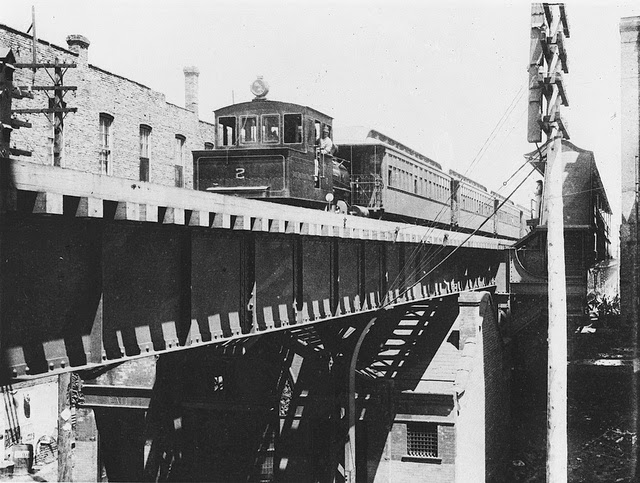
The cars were pulled by diminutive suburban locomotives designed to operate without the necessity of turning the locomotive for the boiler to face forward for the return trip.  The IC gathered engineers from around the system to meet the demand for frequent trains, including one John Luther "Casey" Jones whose death in a wreck years later would propel him into folklore legend.  In preparation for the fair the IC had also elevated a portion of it's track above street level, adding new express tracks to handle the volume of trains.  A branch from the main track at 71st Street would lead to the Fair's station.  A direct connection was also provided by the Baltimore and Ohio Railroad.  Other railroads would run special "Exposition Flyers" express trains to the city.

South Side Elevated train.

Cable cars were put to the test on the Fair's busiest day.

 The Calumet Electric Street Railway operated streetcars before the City of Chicago.

The South Side Elevated train, also known as the "Alley El", was completed in 1892 and then extended to the fairgrounds in Jackson Park.  Their terminal station was situated between the railroad station and the Transportation Exhibits Building.  It too connected with the Intramural train.  Much like the IC, the elevated trains were pulled by diminutive steam locomotives known by the last name of their inventor Mathias Forney.  Chicago's cable car system, which predated electric streetcars, ran to the Fair as well.  Finally the electric streetcars of the recently completed Calumet Electric Railway connected residents from suburbs and towns to the south of the city with the Jackson park site.  The Fair was well-served by the various forms of rail transportation.

Intramural Railroad train passing the windmill exhibit.

Within the Fair itself the electrically powered Intramural Railway, which shuttled passengers between the various exhibition halls, was a harbinger of the future of urban public transportation.  Operating on elevated tracks throughout the fairgrounds it presaged the eventual electrification of mass transit systems like the South Side Elevated.

Front elevation of the station.

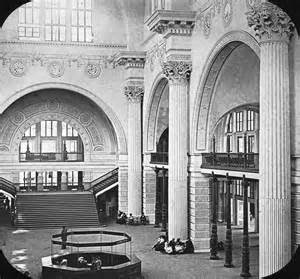
Station waiting room.

The clocks surrounding the waiting room displayed times from around the world.

The Fair station would probably be ranked as the largest and busiest railroad station in Chicago based on the number of platforms and the volume of traffic handled daily.  It's classical styling would portend the architecture of many stations built following the Fair.

Transportation Exhibition Building

It sat in juxtaposition to it's neighbor, the Transportation Exhibition Building designed by Louis Sullivan.  In contrast to the station's design that kept with the classical theme of the Fair's architecture, Sullivan's building was a riot of color and ornament.  Prior to the Fair Sullivan and his partner Dankmar Adler had designed two stations for the IC, a commuter station at 39th Street in Chicago and the main passenger terminal in New Orleans.  Sullivan's brother Albert worked for the IC and was probably responsible for those commissions to the firm.


Built as temporary structures, many of the Fair's buildings succumbed to a series of spectacular fires that laid waste to the abandoned Fair site after it's closure.  The Fair did more than represent a fantasy city of the future, a dreamland of canals flanked by ornate buildings designed to awe and amaze.  It showed the possibilities of coordinated mass transportation and it's ability to move people with great efficiency.


Saturday, March 22, 2014

STRIKE!


Chicago's ascendancy to the nexus of the nation's rail network also brought about the creation of numerous industries that came to supply the railroads.  The greatest of these was the Pullman Palace Car Company started by George Pullman in 1858.  Pullman's business grew, and by 1879 he decided to build a self-contained factory community far beyond the limits of the city.  Pullman's idea was to create what he considered a 'workers paradise' free of the distractions and vices that might impede worker productivity.  His shrewd business plan was to not only control the complete production process, but to also control the lives of the people who built his cars as well as the families they supported.  In 1883 one Pullman worker famously opined, "We are born in a Pullman house. We are fed from a Pullman shop, taught in a Pullman school, catechized in the Pullman church and when we die we shall be buried in a Pullman cemetery and go to a Pullman hell."

Workers rental homes

1893 was an auspicious year in Chicago's history.  The World's Columbian Exposition had drawn millions of visitors to the 'White City' on the south lakefront.  The fair announced to the nation and the world that Chicago was a city to be reckoned with, risen from the ashes of the Great Fire flexing it's industrial and cultural might for all to see.  But 1893 was also the beginning of an economic depression that would put a damper on the city's great coming out party.  By 1894 the downturn had a deleterious affect on Pullman's business, and he cut his workforce by three quarters.  This had an unintended affect on his bottom line, as well as his paternalistic vision of the Town of Pullman.  To rectify the situation Pullman began to produce new cars at a loss, allowing him to hire back 68% of his workforce.  He also cut the rate of pay by 28% and refused to lower the rents of his worker's homes, expecting to maintain his return on investment.  He made no mention to his workforce that he was operating the business at a loss.

 A labor publication's cartoon portrayal of Pullman

Negative newspaper accounts began to be printed detailing starvation and privation in the 'workers paradise'.  Pullman was unswayed by the negative publicity.  To his mind owning the factory and the town gave him the inalienable right to operate his business without outside interference.  Pullman had weathered an earlier labor dispute in 1886 that led to a short, unsuccessful strike.  On May 4th, 1894 a commitee of workers met with the company's Vice President to request a restoration of wages or a reduction in rents, along with an end to managerial harassment.  Their pleas fell on deaf ears.  Three day later three members of the negotiating committee were fired without explanation.  The stage was now set for the Pullman strike.

Eugene V. Debs

About one third of the Pullman workers had joined the nascent American Railway Union (ARU) led by the charismatic Eugene V. Debs.  At the June ARU convention in Chicago the Pullman members asked for support from the union by declaring a sympathy boycott of all trains carrying Pullman cars.  Debs was cautious about the effects of the boycott on the newly formed union, but in the face of Pullman intransigence the delegates were left with no option but to vote for a boycott.  The battle lines were drawn between the union and Pullman, who was supported by the General Managers Association (GMA) of the various railroads affected.  The ARU was a dangerous adversary to the power of the railroads, and allowing them a victory was anathema to the GMA.  Significantly, the ARU did not receive support from other railroad brotherhoods and the American Federation of Labor (AFL), led by the powerful Samuel Gompers.  Despite these obstacles, the ARU was able to effectively shut down rail traffic in 27 states west of Chicago.

Army encampment in Lake Front Park

In the beginning the strikers had the support of the citizenry as well as numerous civic and political leaders.  The dispute began peacefully, but quickly devolved into a unprecedented spasm of violence and destruction.  The first sign of trouble took place in Blue Island, south of the city.  This was all the provocation necessary for the GMA to call upon the Federal government to step into the dispute.  On July 4th President Grover Cleveland ordered 10,000 troops sent from Fort Sheridan, a military camp north of the city established after the violence of the Haymarket Riots in 1886.  Concurrently, the US Attorney General applied to the courts for an injunction against the strikers for violating provisions of the Sherman Anti-trust Act governing interstate commerce.  The presence of armed federal troops, police and Pinkerton detectives coupled with the action of the courts only inflamed the increasingly tense situation.
 
Panhandle (Pennsylvania) Railroad Yards set ablaze

Cartoon portraying Debs as an obstruction to commerce.

Rail yards, filled with wooden railroad cars typical of the era, were set aflame by working class sympathizers of the strikers.  Trains were blocked, crews pulled from locomotives.  Soldiers clashed with protesters and shots rang out.  The Illinois militia was sent to intervene between the Chicago's working class citizens and the Federals.  Force was employed to bring trains through blockades, and in the end 13 were killed and 53 seriously wounded.  Public opinion, inflamed by lurid press accounts of the violence, turned against the boycott.  Debbs attempted to end the boycott early by asking for a return to arbitration, but the Pullman Company now had the upper hand and he was rebuffed.  Chicago trade unionists called for a general boycott, but a quickly called meeting of the AFL leadership counseled against such a move.  Debs and the ARU leaders were arrested for defying the injunction.  The strike lingered to September when the last 2000 strikers unconditionally gave up their cause.

Federal troops fire on strikers and sympathizers

Troops and Pinkerton guards strike a pose

Workers were rehired on the condition they renounce the union.  The strike leaders were blacklisted.  George Pullman, who had escaped the city during the turmoil, had won.  But is was a pyrrhic victory.  A subsequent federal investigation into the strike placed much of the blame squarely on the Pullman Company and it's unwillingness to negotiate fairly with it's workers.  A year after Pullman's death in 1897, the company would be forced to divest itself of all property not used for industry.  The Town of Pullman would later be annexed and become part of the City of Chicago.  The industrial labor movement was discredited and badly damaged by the strike and boycott.  Decades would pass before it would recover and reassert itself.

Fairgrounds reduced to cinders

In a moment of supreme irony, a number of fires destroyed the now abandoned buildings of the Great White City of the Columbian Exposition within 9 months of it's closing.  The burnt site now seemed to epitomize the end of so many grand visions for the city and the harsh reality of the deep class divisions within American society.